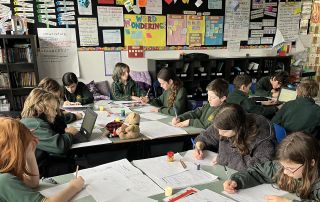
Mathematics at Emerald Primary School focuses on developing students’ understanding of mathematical concepts, processes and the ability to apply this knowledge effectively to real life situations. Students are provided with authentic numeracy learning experiences that are challenging, exciting and enjoyable. Structures within all classes cater for individual differences through the provision of open-ended learning activities as well as differentiated focus groups and tasks.
During Mathematics learning at Emerald Primary School all students are supported to develop a growth mindset. This is the understanding that everyone can change and grow through application and experience. Students are frequently asked to explain where they are in the ‘Learning Pit’ throughout a Mathematics topic and are supported through differentiated tasks and small focus groups to have those ‘a-ha’ moments.
The Victorian Mathematics Curriculum consists of three overarching Strands. These are Number and Algebra, Measurement and Geometry and Statistics and Probability. Within each of these strands there are a number of key curriculum components that are taught specifically for each Year level.
- Mathematics Lessons/Workshops: Our general Mathematics lessons take the following structure:
The ‘Engagement’ section or ‘Tune In’ introduction, where the students’ learning focus for the lesson is explained WALT (We Are Learning To), discussed and examples demonstrated. - The ‘apply’ section involves students working through mathematical problems and building confidence in the concept. Students will rotate through a mixture of explicit teaching focus groups, strategy or skilled Maths game groups, consolidating mathematics skills worksheet groups and online Maths program groups.
- The ‘Reflection’ stage of the lesson allows students to look back on their learning (did they achieve the WALT), ask questions, receive feedback, share findings and discuss the real life relevance of the Mathematical concept being taught.
As well as our explicit teaching workshops around the key curriculum components for each year level, Emerald Primary School has two Programs that support our students’ development of essential Mathematical skills:
Emerald Primary School is proud to offer our students the ‘Maths Masters’ program which is embedded across the whole school. This engaging Numeracy program aligns with Dianne Siemen’s ‘Developing Big Ideas in Number’ and was created based around the research and findings that reiterate the importance of developing the key concepts of Number Sense. This development of Number Sense in our students has a direct correlation to success in Numeracy.
Maths Masters is carried out by all classes for one hour per week where students work through the different coloured belts (White, Yellow, Green, Brown, Black and Platinum), aiming for mastery in each of the skills within that belt. Belts are developed sequentially with the concepts within each belt becoming increasingly difficult. Goals are set with the teacher during teacher/student conferences, and students then work on mastering one skill at a time.
We encourage parents to be an active part in this program, and you can assist your child to learn the required skills through the links within this website. Hopefully, this is an enjoyable way of assisting your child’s growth in Numeracy as well as celebrating their success.
Maths Investigation Buddies (MIB)
MIB sessions follow the inquiry instructional model ‘Launch Explore Summarise’ which supports students to build their problem-solving and reasoning skills in Mathematics. The program encourages children to learn by exploring challenging problems together, in a student driven- partner based approach, rather than being shown exactly what to do by the teacher.
How it works:
- Students work in pairs (their “buddies”) to share ideas and test out different strategies for solving tricky maths problems.
- Problems are designed to be challenging so that children need to think hard, keep trying, and work together.
- Teachers don’t give answers but instead ask questions that encourage students to explain and improve their thinking.
Lesson structure:
- Each MIB unit has four lessons.
- In the first three lessons, students tackle similar problems so they can build on their learning each time.
- The final lesson, called the Publishing Lesson, is when students choose one problem and show their best reasoning. They improve or clarify their work by making small changes and adding detailed explanations.
What happens in class:
- The main part of the lesson is focused on ‘productive struggle’. This means students are expected to try, experiment, and work through challenges before finding a solution. They might use drawings, hands-on materials, or step-by-step methods.
- While students are working, teachers don’t step in with answers. Instead, they ask guiding questions such as:
- Can you show me?
- Can you explain what you’ve tried?
- How do you know that works?
- Can you solve that a different way?
- At the end of the lesson, the teacher invites several students to share their strategies with the class. This helps everyone learn from each other and see different ways of solving problems.
Key point for parents:
It’s normal for students not to solve the problem straight away, especially in the first lesson. What matters most is that they practise sticking with a problem, trying new strategies, and explaining their thinking. Over time, students build stronger reasoning skills and confidence in tackling complex maths problems, as well as learning new strategies and methods from peers.
At Emerald Primary School Mathematics is a fluid moving, student needs based, type of Maths Workshops. The Mathematics teaching sequences are Pre/Post-Test model which directly identifies the individual learning needs of students, allowing for explicit, targeted teaching and allows students’ learning growth to be clearly identified.
Assessment and evaluation will be an ongoing part of the classroom program, consisting of teacher-created assessment tasks, observations and the online platform Essential Assessment; which is a tool used across all levels to determine what students already know and what their future learning needs are in specific areas of Mathematics. Essential Assessment allows students to complete an online pre-test, then assigns individual learning tasks based on identified areas of improvement. Finally, students and teachers are able to measure progress by completing an online post-test. Students have access to these individualised tasks both at school and at home via the online My Numeracy portal. Classes from Year 2 to 6 utilise this program frequently to support planning and assessment, while the Prep and Year 1 students are exposed to the program throughout the year.
In Foundation, students are involved in the Mathematics Online Interview. This is a resource for schools to use when planning and implementing a strategic and comprehensive approach to early years mathematics teaching and learning for all students in the first five years of schooling.
At Emerald Primary School, we have a Mathematics Learning Specialist and a Mathematics PLT Leader available to support teachers with assessment, planning and professional development. As well as this, students’ Mathematics learning is supported and extended by our Tutor, Intervention and High-Abilities (VHAP and VCES) Programs which provide targeted extension and intervention support to students throughout the school.
Find out more about our tutoring program here:

COURSE TUTORS